

Damper Setting is…
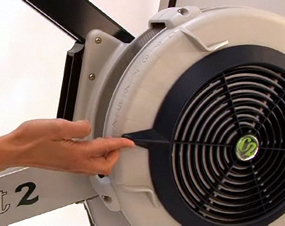 The damper is the lever on the side of the flywheel housing, or fan cage, that controls how much air flows into the cage. The fan cages on our later indoor rowers (Model C and later), are numbered so you can set the damper lever to a particular value from 1–10, indicating how much air is drawn into the cage on each stroke:
- Higher damper settings allow more air into the flywheel housing. The more air, the more work it takes to spin the flywheel against the air. More air also slows the flywheel down faster on the recovery, requiring more work to accelerate it on the next stroke.
- Lower damper settings allow less air into the flywheel housing, making it easier to spin the flywheel.
Damper setting is similar to bicycle gearing: it affects how rowing feels but does not directly affect the resistance. A lower damper setting on the indoor rower is comparable to easier gears on a bike.
Damper Setting is Not…
Many people confuse damper setting with intensity level or resistance. Instead, the intensity of your workout is controlled by how much you use your legs, back and arms to move the handle—in other words, how hard you pull. This is true regardless of where the damper lever is set: the harder you pull, the more resistance you will feel. Because our indoor rowers use wind resistance (which is generated by the spinning flywheel), the faster you get the wheel spinning, the more resistance there will be.
Think about rowing on the water. Regardless of whether you are rowing in a sleek racing shell, or in a big, slow row boat, you will need to increase your intensity and apply more force to make either boat go faster. The difference is in how it feels to make the different boats go fast. Making a sleek boat go fast requires you to apply your force more quickly. Making the slow boat go fast also requires more force, but the speed at which you apply the force will be slower over the course of the rowing stroke.
At a damper setting of 1–4, the indoor rower feels like a sleek racing shell; at the higher numbers, the indoor rower feels like a slow row boat. Regardless of the setting, you will need to increase your effort to increase your intensity.
Drag Factor: How True Effort is Calculated
You might be tempted to think that rowing on the highest setting will result in your best score. This is where the Performance Monitor comes in.
Between each stroke, the PM measures how much your flywheel is slowing down to determine how sleek or slow your “boat” is. This rate of deceleration is called the drag factor. On your next stroke, the PM uses the drag factor to determine from the speed of the flywheel how much work you are doing. In this way, your true effort is calculated regardless of damper setting. This self-calibration is what allows us to compare scores from different indoor rowers, making things like indoor racing and the online world rankings possible.
Different indoor rowers can have different drag factor ranges. A damper setting of 3 on your home machine may feel like 4 on the machine at the gym. Differences in air temperature, elevation—even how much lint is caught in the flywheel housing—can all affect the drag factor from machine to machine. When using different machines, you may need to adjust the damper setting to achieve the drag factor and feel you prefer. See How to View Drag Factor for information on checking the drag factor on your machine.
What Damper Setting to Use
With a little experimentation, you will find the damper setting and drag factor that work best for you. We recommend starting out on a damper setting of 3–5. Really focus on technique, and as you improve, you may find that a lower damper setting gives you the best workout and results. Resist setting the damper lever too high; this can exhaust your muscles before you reap the full cardiovascular benefit rowing provides. The Performance Monitor will give you immediate feedback on each stroke so that you can monitor your performance and determine where you get your best results.
You can also vary your damper setting to achieve different types of workouts. In general, lower damper settings are best for aerobic workouts, while higher damper settings make rowing more of a strength workout.
More on Damper Settings and Drag:
Debunking Myths: Damper Setting, Stroke Rate and Intensity
Damper Settings of Olympians